


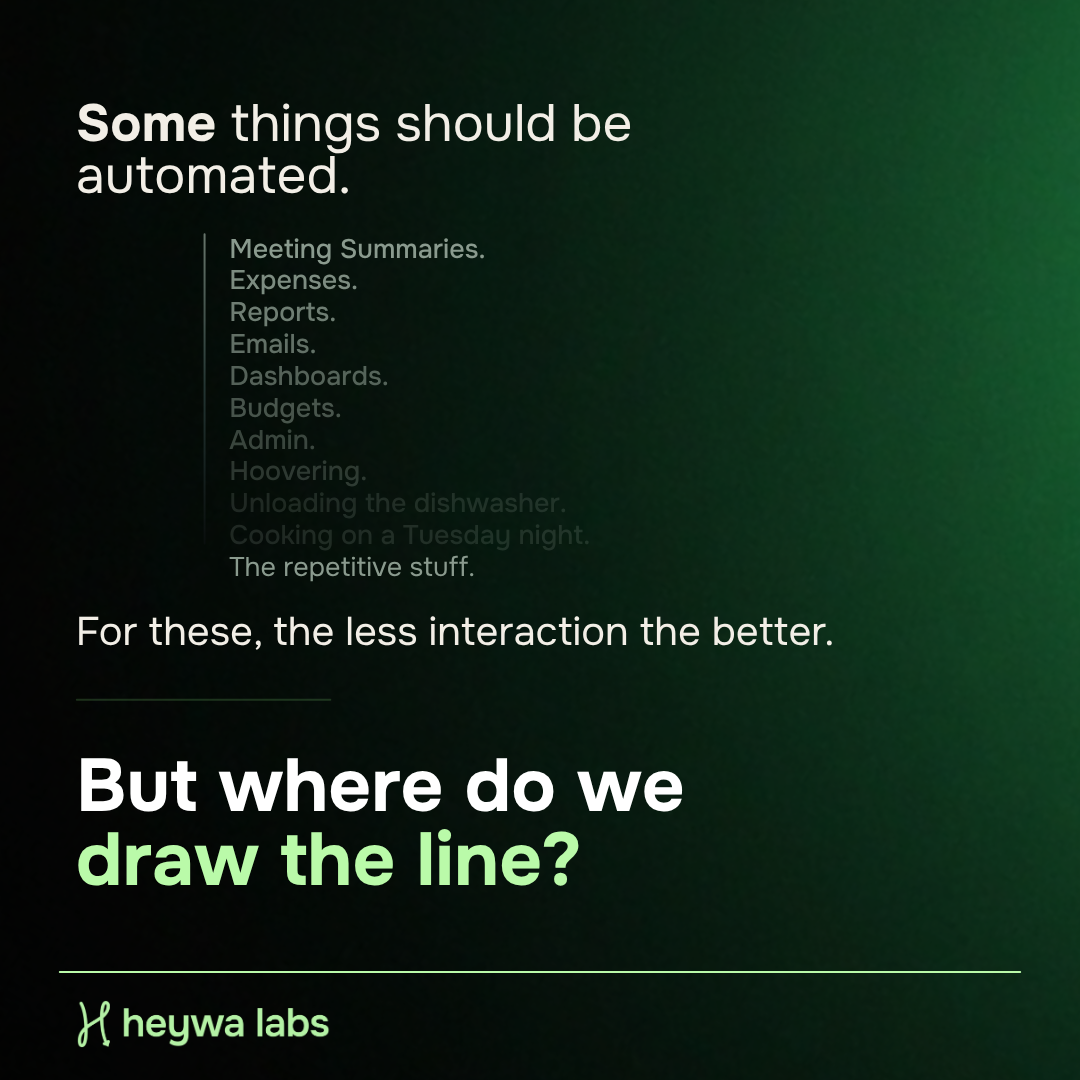
A lot of the current conversation around AI seems to assume that the ideal end state is full automation. The interface disappears, agents take over, and humans simply describe outcomes while systems execute on their behalf. And for some categories of work, that future makes perfect sense. I’m very happy for AI to summarise documents, organise information, handle repetitive admin, or automate operational tasks I don’t particularly enjoy doing in the first place. There are many areas where reducing friction is genuinely useful, and where the ideal experience probably is minimal interaction.
But there’s another category of experiences where I increasingly think full automation is the wrong goal entirely.
Travel is probably the clearest example for me. I love planning trips, sometimes more than the trip itself. I like comparing neighbourhoods, reading reviews, imagining different versions of the holiday, refining ideas over time, discovering places I didn’t know existed, and slowly building conviction around a decision. Even shopping for furniture, choosing restaurants for a night out, or planning weekends with friends often has a similar dynamic. These aren’t just tasks to complete as efficiently as possible. The exploration itself is part of the value.
Could an AI agent probably plan a better £6k family holiday than I could? Potentially yes. But I still wouldn’t want it to silently decide everything for me and come back with a completed booking. I’d want to understand why it made certain choices. I’d want to compare alternatives, tweak priorities, steer the process, and stay involved in the decision-making. Not because I necessarily distrust the technology, but because participation is part of what makes these experiences meaningful in the first place.
That tension has made me increasingly sceptical of the idea that AI will eliminate interfaces entirely. In many categories, I suspect the opposite is true. The smarter the systems become, the more important the experience around them becomes too.
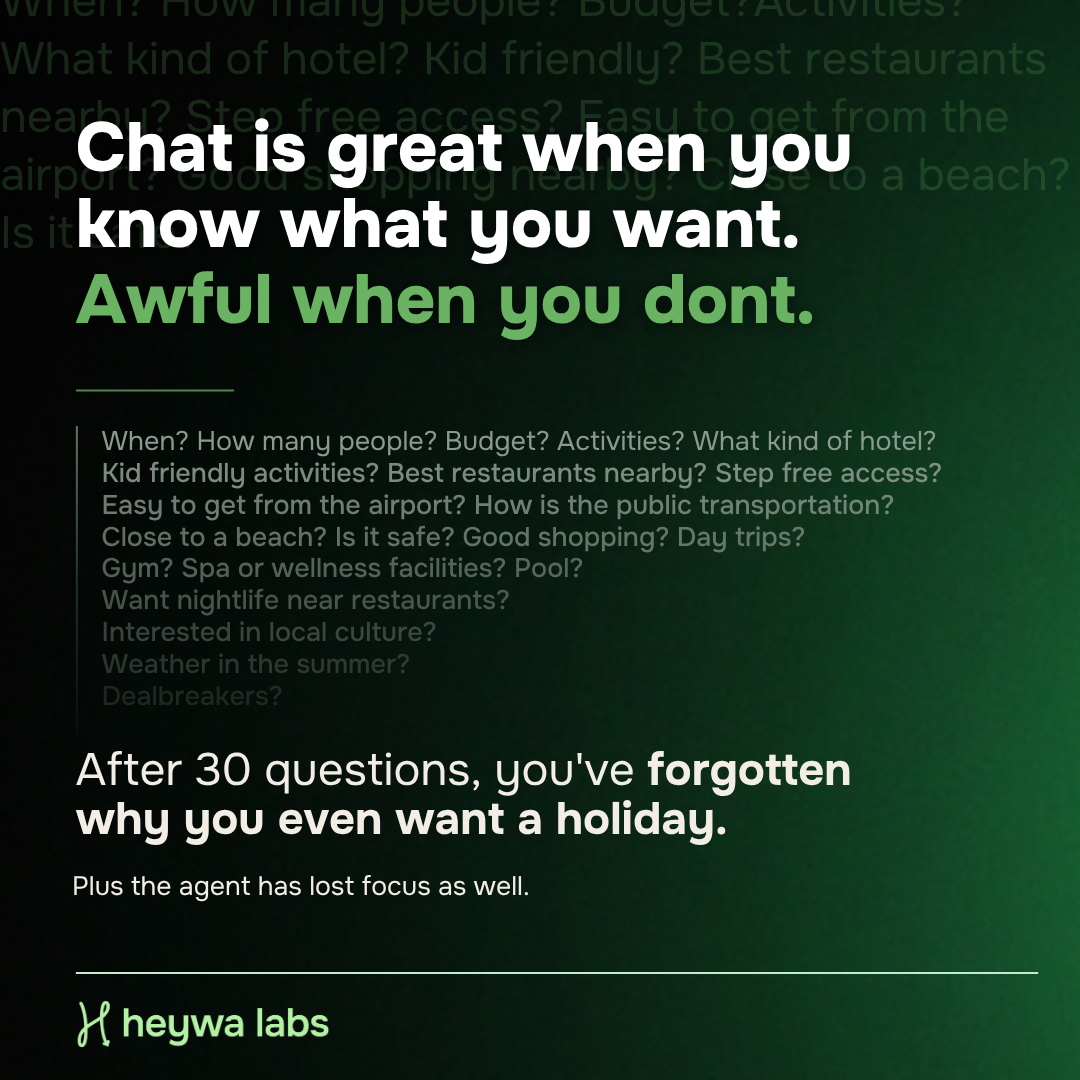
One thing I’ve noticed while using many current AI products is that they work brilliantly when I already know what I want. Book this. Summarise that. Reorder the usual. Handle the admin. But they often become strangely frustrating the moment I’m still figuring things out.
A good example is travel planning. You say:
“I want a holiday in Thailand.”
The AI asks:
“When?”
You reply.
“How many people?”
You reply.
“What budget?”
You reply.
“What activities do you enjoy?”
You reply.
“What type of accommodation?”
You reply.
After a while, the interaction starts feeling less intelligent and more exhausting. And I think the reason is that the real bottleneck often isn’t information retrieval. It’s helping people form and refine intent.
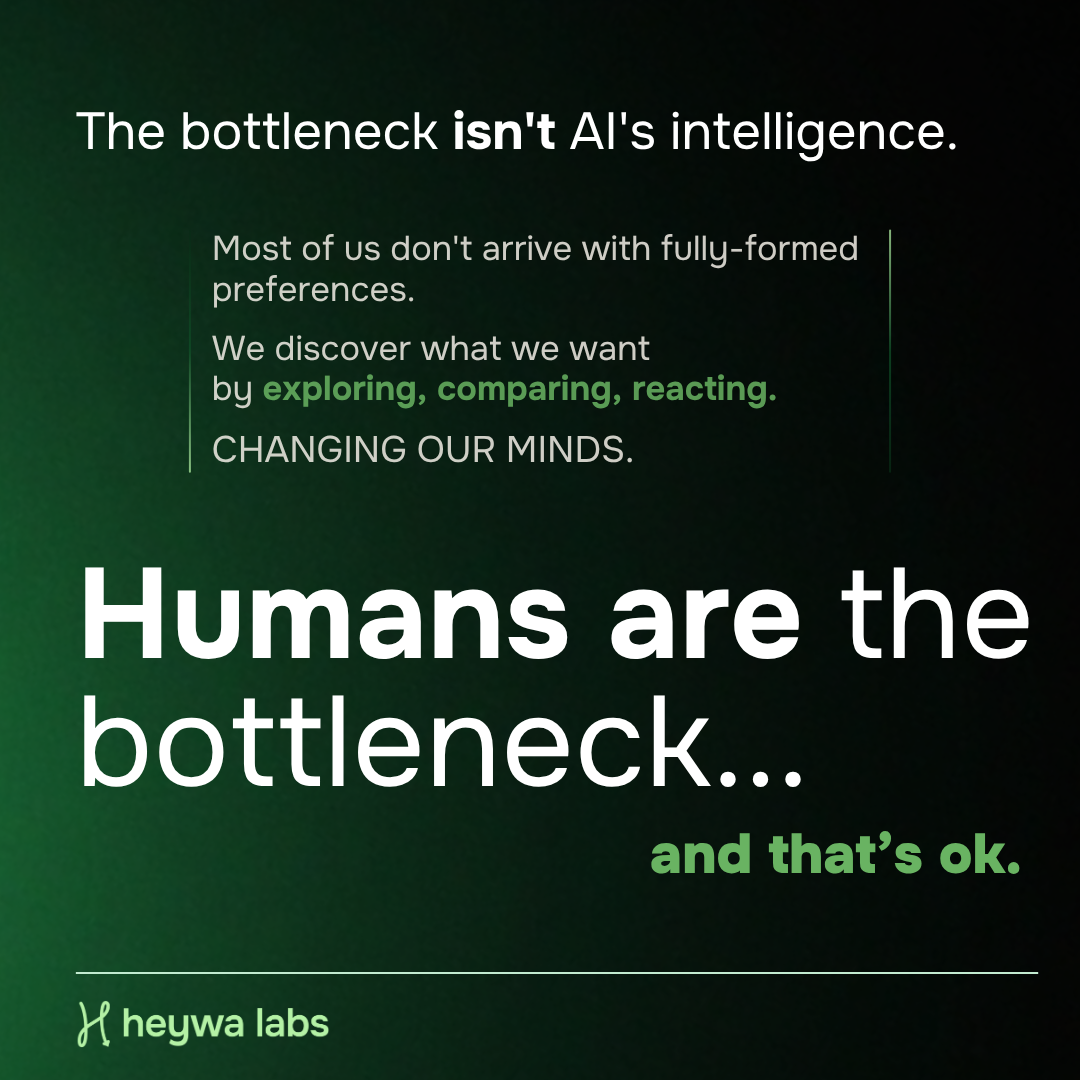
Most of us don’t arrive with fully-formed preferences ready to input into a system. We discover what we want through exploration itself. By reacting to options, comparing tradeoffs, changing our minds, seeing examples, discussing possibilities, and gradually building conviction over time.
Even travel preferences are surprisingly contextual and dynamic. We only take a few major trips a year. Our priorities evolve. Sometimes we don’t even know what matters to us until we see it. A family beach holiday, a romantic weekend away, a food-focused trip with friends, a quiet wellness retreat, and a two-week adventure trip all require completely different tradeoffs, even from the same person.
That’s why I increasingly think many current AI interfaces are solving the wrong problem.
Traditional search gives us links and filters. Newer AI products increasingly collapse everything into chat. But exploratory decision-making rarely happens in a straight line. You branch, compare, save options, reconsider, pivot, and slowly build confidence over time. Chat is excellent for execution efficiency, but much weaker for exploration.
And I think this is where many current AI interfaces start to feel strangely limiting despite the underlying intelligence being so powerful. The challenge is not simply gathering more information faster. In many cases, humans themselves are the bottleneck. We are still learning about the space, refining our own preferences, and trying to understand what we actually want.
Which also makes me question how much “AI agents working in the background” truly save time in these categories. If the core challenge is not crawling websites but helping humans shape intent and build confidence in decisions, then hiding the process entirely may not actually create a better experience at all.
I also think trust becomes much more important as the stakes rise. I’d probably trust AI to book a £50 train ticket for me without checking much. I would absolutely not trust it to spend £6k on a family holiday without showing me how it got there. If AI is helping me make a meaningful decision, I don’t just want an answer dropped out of a black box. I want visibility into tradeoffs. I want to understand why certain choices were made. I want to stay involved in the process before committing.
At that point, the challenge stops being purely about model capability and starts becoming a question of experience design. How do users steer the system? How do they explore alternatives? How do they build trust? How do they maintain a sense of agency while still benefiting from automation?
I suspect these questions will become increasingly important over the next few years, especially in discovery-heavy categories like travel, commerce, entertainment, food, and lifestyle. The future of AI probably isn’t “humans disappear, agents do everything.” More likely, humans and AI collaborate in new ways.
And that means interfaces are not disappearing. They are evolving into something much more adaptive, interactive, and dynamic than the static software patterns we’ve used for the last twenty years.
AI should remove the work, not the experience.